
Is your business ready for SASE? 7 signs it is time to adopt
Seven signals that the network you have built cannot scale, and what changes when networking and security converge.
At first, things run fine. The VPN handles most connections, MPLS still links your sites, and you have patched on enough point products to cover today’s threats. Everything works until it does not: performance tanks, support tickets spike, and security feels scattered.
The bigger the business grows, the more tangled it becomes. You are not managing your network anymore, you are managing workarounds. That is the moment many IT leaders reach a quiet breaking point.
What SASE is
SASE is a cloud-delivered framework that converges network and security functions into one unified platform. Instead of relying on legacy infrastructure like MPLS circuits or standalone security appliances, it enables secure, direct-to-cloud connectivity through a global network of distributed points of presence.
That means users, no matter where they are, connect securely to applications and data without backhauling traffic through a central data center or patching together multiple tools. The core technologies behind it:
- SD-WAN
- Intelligent, optimized traffic routing.
- Zero Trust Network Access
- Secure access without exposing internal networks.
- Cloud firewall and threat protection
- Consistent security policy enforced everywhere.
- CASB and DLP
- Visibility and control over cloud apps and sensitive data.
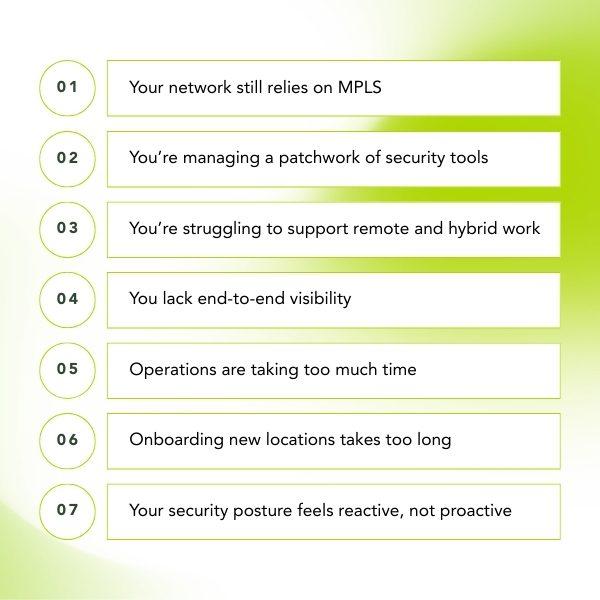
1. Your network still relies on MPLS
MPLS made sense when apps lived in the data center and branches needed a private line back to headquarters. Now users are remote, apps are in the cloud, and bandwidth needs shift daily. Opening a new branch means waiting weeks for circuit provisioning; improving Microsoft 365 performance means backhauling traffic through a hub and adding latency; and rigid carrier contracts leave little room to cut costs.
- Old model
- You deploy an MPLS circuit to a new site, coordinate with your carrier, and wait 30 to 60 days for activation.
- SASE model
- You drop-ship a lightweight edge device and users are securely online the same day through cloud-native provisioning.
2. You are managing a patchwork of security tools
Security tools multiply over time. As new threats emerge, teams add what they need until they are managing an overlapping collection of products that do not speak the same language. Each system brings its own policy engine, alerts, and dashboard, and when the stack gets too fragmented, blind spots and inconsistent enforcement creep in.
- Old model
- Four or five security tools from different vendors, each with its own policy engine and alerting logic. Aligning them takes manual work, and gaps emerge between the cracks.
- SASE model
- ZTNA, firewall, threat protection, and CASB are delivered as a unified platform. Policies are written once and enforced everywhere.
3. You are struggling to support hybrid work
When work went remote, most teams made it work with what they had: VPNs, split tunneling, and full network access for users logging in from anywhere. That temporary fix is still in place for many organizations, and it shows up as slow performance, overprovisioned access, and limited visibility into who is connecting to what.
- Old model
- Users connect to the corporate network over VPN. Performance slows at peak hours, access cannot be restricted to just the apps people need, and onboarding takes manual effort every time.
- SASE model
- Users connect through ZTNA to the nearest cloud point of presence. Access is app-specific rather than network-wide, and authentication is continuously verified.
4. You lack end-to-end visibility
Modern environments mix SaaS apps, branch offices, cloud workloads, and remote endpoints. Without centralized visibility, even simple questions turn into investigations. When security and networking tools operate in silos, context disappears, incidents take longer to detect, and policies drift.
- Old model
- Separate tools for endpoint monitoring, cloud access logs, network analytics, and threat detection. Piecing together the full picture takes time.
- SASE model
- Visibility is built in. Every user, device, connection, and application is monitored through a centralized control plane.
5. Operations are taking too much time
When infrastructure gets too complex, routine tasks turn into time sinks: updating policies, troubleshooting performance, coordinating between vendors. Scripts and workarounds help, but they are band-aids. If operations feel slow, manual, or vendor-dependent, the architecture underneath is getting in the way.
- Old model
- A policy change means logging into multiple platforms, reconciling syntax, and hoping everything syncs.
- SASE model
- Policy changes, updates, and patches are pushed from the cloud and enforced consistently. Troubleshooting is centralized and changes happen in hours.
6. Onboarding new locations takes too long
Bringing new branches online should not be a logistical exercise in ordering circuits, shipping firewalls, configuring by hand, and coordinating vendors. Whether you are expanding into new markets or integrating acquisitions, the delay slows the business down, not just the timeline.
- Old model
- Source MPLS, wait weeks for delivery, stage physical hardware, and configure security on site.
- SASE model
- New sites are onboarded with cloud-native provisioning and lightweight edge devices, mostly handled remotely.
7. Your security posture feels reactive
Alerts come after an incident, patches roll out days later, and threats surface once someone has already clicked. Most security teams are putting in the work, but their tools keep them in reactive mode. Without shared context across users, traffic, and behavior, detection lags and response times stretch.
- Old model
- Tools log and flag events after they occur. Analysts triage alerts manually and enforcement happens later, if at all.
- SASE model
- Threat detection, policy enforcement, and user behavior analytics happen in real time, applying controls at the edge before problems spread.
You have outgrown the old model
Latency issues, tool sprawl, delayed rollouts, and mounting overhead all point to the same shift. Most teams reach this inflection point quietly: performance slips, complexity creeps in, and security becomes reactive.
SASE offers a single-vendor, cloud-delivered platform that unifies networking and security and scales with the business instead of slowing it down. If you are seeing even one of these signs, it is worth exploring what a purpose-built platform could unlock.